
In the late 2000s, everyday American English started to sound unmistakably more digital, more finance-aware, and more platform-shaped. That shift did not happen in a vacuum. Mortgage jargon jumped from lender paperwork into dinner-table talk, social media habits turned into verbs, and political branding began to travel at the speed of a timeline refresh. Consequently, the “new words” that gained traction in 2007, 2008, and 2009 now read like a diagnostic log for a culture moving from desktop-era web to the always-on, algorithm-fed internet that defines modern life.
Moreover, these years sit at a crossroads that still matters in 2026. The financial crisis rewired how people talk about risk. Meanwhile, Twitter popularized short-form broadcasting, therefore giving English a new set of tools for public signaling, indirect conflict, and micro-commentary. At the same time, lexicography groups such as the American Dialect Society (ADS) kept a careful record of what caught on, what stayed niche, and what reflected the public conversation. The original list of 19 items from 2007–2009 offers a compact, practical reference for neologisms, word meanings, and the kind of semantic change that turns a technical term into cultural shorthand.
En bref
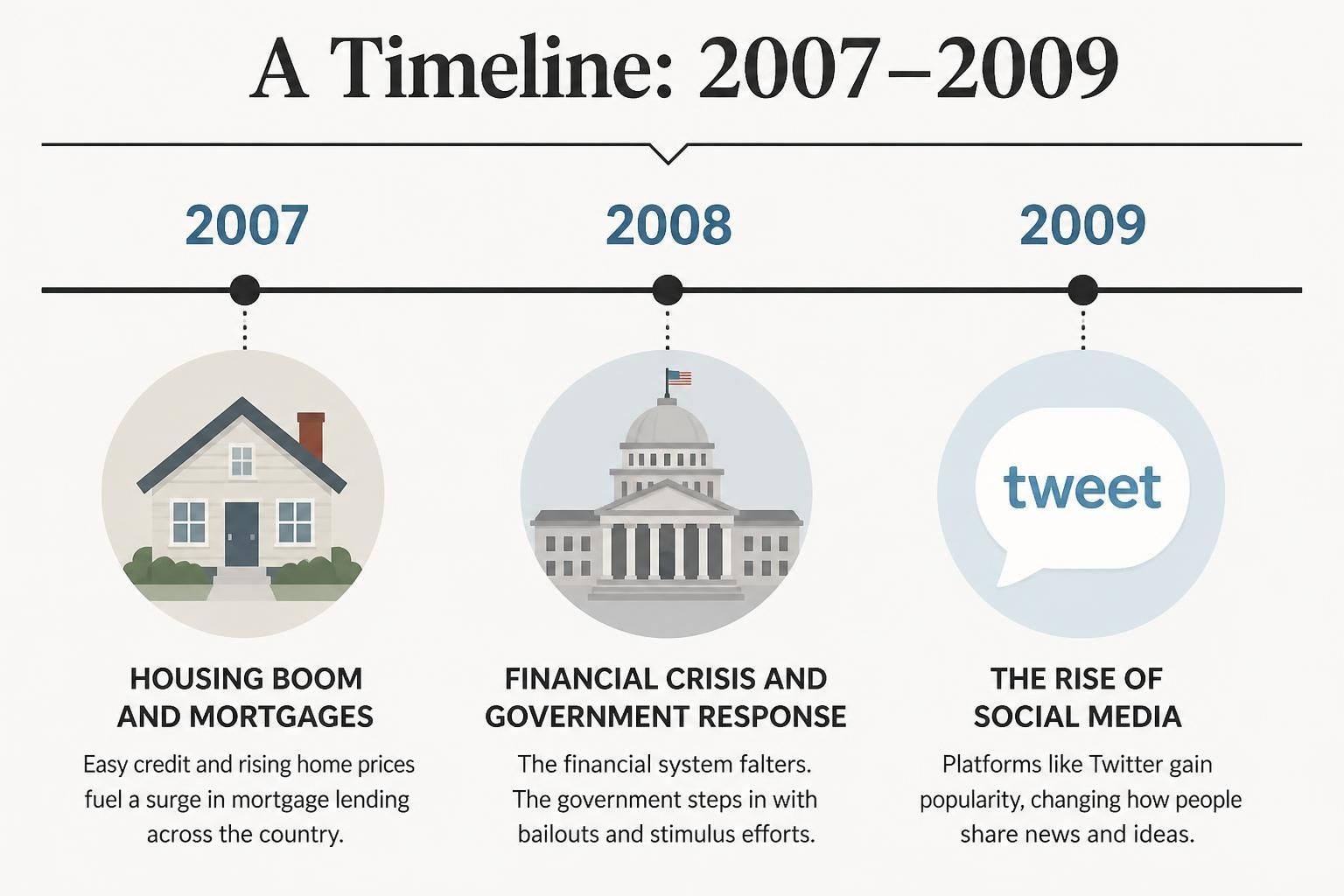
- 2007 centered on financial risk and environmental framing, with “subprime” and the productive green- prefix moving into wider public speech.
- 2008 captured crisis-response vocabulary, as “bailout” became a household term and “shovel-ready” promised fast action.
- 2009 highlighted platform communication, with “tweet” defining a new default unit of public text.
- The lists also documented categories like Most Useful and Most Euphemistic, which reveal social pressure around wording.
- Seen from 2026, these entries map directly to today’s debates about dictionary updates, misinformation, and how tech products reshape language evolution.
2007 New Words and Word Meanings: “Subprime” and the Green- Prefix as a Snapshot of Language Evolution
In 2007, the American Dialect Society selected “subprime” as its Word of the Year, and that choice still reads like an early warning label. The term started as lending vocabulary. However, it quickly escaped bank offices and entered nightly news coverage. As a result, many people learned a new finance concept through headlines, not textbooks. That pathway matters because it shows how lexicography often follows attention rather than invention.
Subprime functioned as an adjective for loans considered riskier than “prime” loans. Yet the word also carried a moral haze in popular speech. People used it to suggest carelessness, predation, or systemic failure. Therefore, the term illustrates semantic change: a technical descriptor became a cultural critique. In addition, “subprime” began to modify more than mortgages. Commentators talked about subprime borrowers, subprime securities, and even “subprime” as a shorthand for bad bets in general.
How “subprime” became a mainstream label for risk
In practice, subprime lending existed before 2007, so the “newness” came from prominence. ADS criteria emphasize that a candidate can be newly popular, not necessarily newly coined. Consequently, 2007 shows how dictionary updates and word-of-the-year selections can spotlight a term right as it becomes unavoidable.
Consider a simple scenario from that era: a home user calls tech support because a family PC slows to a crawl. The underlying issue might be spyware. Still, the conversation turns to money because the same household just refinanced. Suddenly, “subprime” enters casual talk alongside antivirus tools and budgeting apps. That mixing of domains marked the period.
The productive “green-” prefix and environmental framing
Alongside “subprime,” 2007 also elevated green- as a prefix/compounding form linked to environmental concern. Unlike “subprime,” green- operates like a toolkit for coining new words. People created greenwashing, green energy, and green initiatives, often to argue over sincerity. Thus, the prefix demonstrates a different side of language evolution: productivity rather than a single headline term.
Moreover, green- helped compress complex policy disputes into compact labels. If a company marketed “green” products while changing little, critics could call it greenwashing. Therefore, a single new word carried a full accusation of misleading marketing. The concept still matters in 2026, especially as AI-generated advertising scales faster than human review.
Other 2007 notables that reveal social pressure
ADS lists often include categories beyond the main winner. For 2007, the list also tracked items such as “googlegänger” (a person with the same name who appears in search results), the playful holiday mashup “Happy Kwanhanamas”, and the euphemistic phrase “human terrain team” for cultural advisers attached to military operations. Each item reflects a different motivation: humor, identity anxiety, or bureaucratic softening.
Altogether, 2007 reads like a year when English tried to label both financial fragility and “eco” positioning. The next year would force those labels into constant use.
That pivot from risk-talk to response-talk leads directly into 2008’s vocabulary.
2008 New Words for the Financial Crisis: “Bailout,” “Shovel-Ready,” and What Lexicography Recorded
If 2007 provided the fuse, 2008 delivered the explosion in public vocabulary. ADS chose “bailout” as Word of the Year, and the word’s rise demonstrates how quickly a complex policy move becomes a single everyday noun. Although “bailout” existed earlier, the 2008 crisis made it unavoidable. Consequently, new words are not always fresh coinages. Often, they are older terms forced into the center of public discourse.
A bailout describes government rescue support for organizations on the brink of failure, particularly large financial firms. Yet the public did not treat it as neutral. People attached emotion, blame, and suspicion to it. Therefore, the word also became a referendum on fairness: who gets help, who pays, and who gets left behind.
Why “bailout” spread so fast
First, the story demanded repetition. News programs had to describe fast-moving interventions in plain language. Second, the word contains a vivid metaphor. “Bail out” evokes removing water from a sinking boat. That image helps comprehension, thus accelerating adoption. Finally, the term fits well into headlines and short-form posts, which were already becoming dominant.
In addition, the bailout debate sparked secondary neologisms and reframings. People used “too big to fail” constantly. They also argued over “moral hazard,” which moved from economics classes into general commentary. That migration shows how dictionary updates often follow public need for quick conceptual handles.
“Shovel-ready” and the promise of immediate action
Also prominent in 2008 lists was “shovel-ready”, describing infrastructure projects ready to start quickly once funding appears. The phrase sounds practical. However, it also became political branding. Officials used it to signal competence and urgency. Therefore, “shovel-ready” illustrates how word meanings expand as slogans travel.
From a consumer-tech angle, the phrase parallels a familiar promise: “plug-and-play.” Both imply minimal friction. Consequently, the public often expected outcomes at software speed. Yet roads and bridges do not deploy like patches. That mismatch helped the term gain a hint of irony in later use.
2008’s euphemisms and workplace inventions
Some 2008 entries also captured the era’s tendency to rename uncomfortable realities. A striking example involved the euphemism “scooping technician” for a person paid to pick up dog waste. Meanwhile, “moofing” (mobile out of office) tried to brand on-the-go work with a catchy label. Many such terms fade, yet they still teach a lesson: organizations often push neologisms top-down, and the public decides whether they stick.
A compact reference table for 2007–2009
The following table summarizes the three headline winners and a few key related items, emphasizing how lexicography connects new words to the moment that popularized them.
| Year | ADS Word of the Year | Core word meanings (plain-English) | Why it mattered in public discourse |
|---|---|---|---|
| 2007 | subprime | Risky loans or financial products below prime quality | Signaled growing credit fragility; later became shorthand for systemic risk |
| 2008 | bailout | Government rescue of failing companies, especially banks | Turned policy into a daily argument about fairness and accountability |
| 2009 | tweet | A short message posted on Twitter; also the act of posting | Defined a new unit of public speech and reshaped political and media habits |
| 2008 | shovel-ready (notable) | Ready to begin immediately once funding arrives | Packaged stimulus plans as fast, visible action |
By the end of 2008, the crisis vocabulary had settled in. Next, social platforms would supply the communication unit that carried those debates everywhere.
2009 New Words for Social Platforms: “Tweet” and the Rise of Compressed Public Speech
In 2009, ADS selected “tweet” as Word of the Year. The choice marked a major shift in language evolution. For the first time, a platform-native unit of text became a mainstream word that almost everyone understood. Moreover, it carried both noun and verb forms with ease. People could read a tweet, write a tweet, and tweet an opinion within seconds. Therefore, the term highlights how digital products can drive dictionary updates through habit formation.
At the time, Twitter’s format forced compression. That constraint shaped style. Users adopted fragments, abbreviations, and punchy phrasing. Consequently, tweet became more than a message type. It became a model for public voice: concise, reactive, and easily shared. In addition, the idea of tweeting normalized broadcasting to strangers, which differed from older email norms.
How “tweet” influenced word meanings beyond Twitter
Even after Twitter rebranded as X, the word “tweet” remained culturally sticky. People still say “tweet” in conversation, although the product name changed. That persistence illustrates semantic change under brand pressure. Sometimes, a term outlives the official label because it fits human memory and speech rhythm better.
Furthermore, “tweet” encouraged a family of related terms: retweet, subtweet (soon after), and tweetstorm. Those derivatives demonstrate morphological productivity, a core interest in lexicography. When speakers start building reliably with a base term, dictionaries take notice. Therefore, “tweet” functioned like a root word for a new public grammar of online interaction.
Indirect speech and conflict: the path toward “subtweet” culture
The late 2000s also trained users in indirect address. Even though “subtweet” appears later in broader dictionaries, the behavior grew early. People began posting messages aimed at someone without naming them, thus creating plausible deniability. That practice shaped later norms across platforms. Moreover, it influenced how journalists quote online conflict, which often relies on inference and context.
For example, a software developer might post “Amazing how some people ship broken updates on Friday afternoons.” The target may feel obvious inside a workplace. However, the message stays vague enough to avoid direct confrontation. This pattern, repeated at scale, helped normalize ambient criticism.
2009’s other tracked terms and why they matter in 2026
ADS lists also included items such as “fail” as an interjection or noun for an obvious mistake, and the vividly named “Dracula sneeze” for coughing or sneezing into the elbow. These terms show how online culture labels micro-behaviors. Meanwhile, the outrageous phrase “death panel” demonstrated how political language can weaponize fear through a compact, repeatable label.
Seen from 2026, this matters because generative tools can now mass-produce persuasive phrasing at low cost. Consequently, the mechanisms that elevated “death panel” and similar labels now operate faster. That speed increases the stakes for careful dictionary updates and responsible reporting.
The next step is practical: understanding how to read word-of-the-year lists as a tool for tracking neologisms, not as trivia.
How to Use Word-of-the-Year Lists as a Reference: Lexicography, Dictionary Updates, and Semantic Change in Practice
Word-of-the-year lists can look like pop culture. However, they function as a lightweight index of language evolution. ADS votes each January at its annual meeting, and the society tracks both winners and category picks. If vote tallies appear next to items, they represent the final counts, and runoffs can appear as split figures. Those details matter because they show disagreement, not certainty. Consequently, a list captures a moment in speech, not a permanent verdict.
Moreover, ADS uses criteria that align with practical lexicography. The words should be demonstrably new or newly prominent, widely used, and reflective of popular discourse. They also should not serve as mere complaints about usage. Therefore, the lists often highlight what people actually said, not what pundits wished they would say.
Reading categories: “Most Useful,” “Most Euphemistic,” and why they predict staying power
Categories reveal motivations. Most Useful tends to reward terms that solve a naming problem, thus boosting longevity. Most Euphemistic identifies language under social pressure, where speakers want to soften impact. Most Outrageous often flags sensational phrases that may burn out quickly. Therefore, categories help you estimate which neologisms might survive.
For example, 2008’s “shovel-ready” offered functional compression. As a result, it traveled well. By contrast, a PR-coined workplace label like “moofing” lacked organic need, so it struggled. That difference matches a common troubleshooting principle: tools that solve a real pain point get used; gimmicks do not.
Connecting ADS lists to dictionary updates and modern search behavior
Dictionaries add words through evidence, editorial judgment, and usage data. In addition, many modern dictionary projects monitor search spikes and citation patterns. Therefore, a word-of-the-year list can act as a companion dataset: it signals which terms captured attention strongly enough to merit closer tracking.
In 2026, the cycle runs faster because platform trends rise and fall quickly. Yet the late-2000s items remain instructive because they show stable drivers of semantic change: crisis, technology, and political framing. If a term names a repeated experience, it persists. If it only decorates a moment, it fades.
A practical checklist for evaluating “new words” today
When you encounter a trendy term, a short checklist helps determine whether it will stick. This is useful for writers, educators, product reviewers, and anyone building documentation.
- Frequency: Does the term appear across multiple communities, not just one platform?
- Function: Does it name a concept that lacked an efficient label?
- Flexibility: Can it act as more than one part of speech, or generate derivatives?
- Stability: Does it survive beyond a single news cycle?
- Clarity: Do people use it consistently, or do meanings drift immediately?
This approach keeps attention on evidence-based lexicography rather than hype. It also prevents overreacting to every new coinage as if it were permanent. The original 2007–2009 set proves the point: some terms became infrastructure, while others became footnotes.
That evidence-based habit sets up the final step: answering the common questions people have when they try to use these lists for writing, research, or everyday communication.
Why were 2007–2009 so productive for neologisms?
Those years combined a major economic crisis with rapid platform growth. Consequently, people needed fast labels for complex financial events, and they also gained new channels that amplified catchphrases and shorthand.
Are word-of-the-year picks the same as dictionary updates?
No. A word-of-the-year list highlights what became newly prominent in public speech, while dictionary updates require broader evidence and sustained usage. However, the lists often predict which terms editors will watch closely.
Did “tweet” remain meaningful after Twitter rebranded?
Yes. Even though branding shifted, “tweet” stayed as a convenient label for a short public post and for the act of posting. That persistence illustrates semantic change where a term outlives the platform’s official naming.
How should writers use these word meanings without sounding dated?
Use the term when it still carries clear meaning for your audience, and add brief context when needed. For instance, “subprime” remains useful in finance writing, while “tweet” may need a platform-neutral explanation in formal documents.
What is the best way to verify a ‘new word’ in 2026?
Check multiple sources: reputable dictionaries, corpus-based tools, and credible journalism. In addition, compare usage across communities to confirm it is not limited to a small trend. This method supports accurate lexicography and careful language evolution tracking.

With over two decades of experience, I specialize in reviewing consumer software and troubleshooting PC issues. At 52, I combine deep industry knowledge with a passion for helping users get the most out of their technology.